

A rack that fits the wall can still fail if its anchors, rope, hinges, or coating cannot handle wet laundry and outdoor exposure. Measure the available space, calculate the real loading conditions, inspect the rope and fixing system, and compare materials before you approve a purchase or installation.
Key takeaways
- Measure clear wall width and full-open projection before ordering.
- Specify rope diameter, material, coating, tensioning method, and replacement access.
- Choose anchors by wall type, not by rack weight alone.
- Load-test every fixing point with wet laundry before regular use.
Measure the wall, projection, and usable drying space
Choose a wall folding cloth drying rack by measuring the clear wall width, not the full wall. Record the rack’s projection when fully opened, the height of its upper and lower fixing points, and the clearance needed for garments to hang without touching nearby surfaces.
| Measurement | What to record | Why it matters |
|---|---|---|
| Clear wall width | Unobstructed width available for the brackets | A skirting board, column, pipe, or corner can reduce the installable width |
| Opened projection | Distance from the wall to the rack’s outer edge | Doors, windows, balcony railings, and walkways may block opening or access |
| Vertical clearance | Heights of upper and lower fixing points | Prevents conflict with ceilings, floors, windows, and furniture |
| Garment clearance | Space beyond the lines for the thickest wet garment | Stops clothing touching the wall, railing, window, ceiling, or floor |
Line count alone does not show capacity. Ask for usable line length, clear spacing between rods or ropes, and the thickest garment assumed; closely spaced lines restrict airflow and slow drying.
Ask for the declared wet-laundry load, not a dry-clothes figure. Confirm whether it applies to a uniformly distributed load or one concentrated point, and whether the frame, ropes, pulleys, and anchors are included.
A 15 kg load at a 0.5 m projection creates about 7.5 kg·m of static bending moment before uneven loading, impact, or user force. Leave enough access to open the rack fully.
Specify and inspect the cloth drying rope
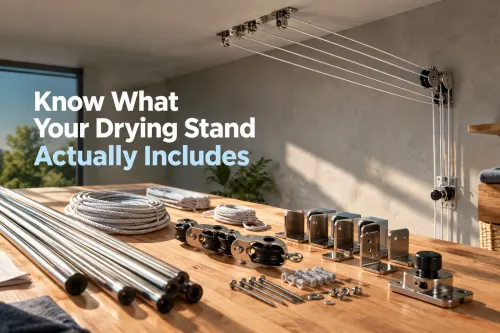
1. Ask for the cloth drying rope’s material, construction, diameter, working load, supplied length, UV-resistance basis, expected stretch, abrasion resistance, and replacement method. Confirm whether the rope is included with the rack or sold separately.
2. Choose the material for the exposure. Braided polyester absorbs little moisture and retains outdoor colour well; nylon usually stretches more and absorbs more moisture. Neither material tolerates sharp bends, heat, burrs, or poor terminations.
3. Inspect the complete route before installation. Check every rope exit, pulley, eye, cleat, knot, clamp, and hook for fraying, flattened sections, loose knots, or slack.
Run a finger carefully along metal contact points and reject sharp edges, small sheaves, misalignment, and tight bend radii; these concentrate abrasion even when the rest of the rope looks new.
4. Identify how the line is tensioned and secured: pulley, cleat, screw, hook, clamp, or rope lock. Ask how to retension it after initial stretch and whether a worn rope can be replaced without removing the rack or opening the wall.
5. Set sag against a stated span and wet load, not diameter alone. For example, specify no more than 50 mm of sag across a 2 m span carrying 10 kg of evenly distributed wet laundry, then record the measurement after loading.
Rope elongation and frame deflection add to geometric sag, so nominal length does not control the installed line height.
Match the anchors to the wall and test the loaded rack
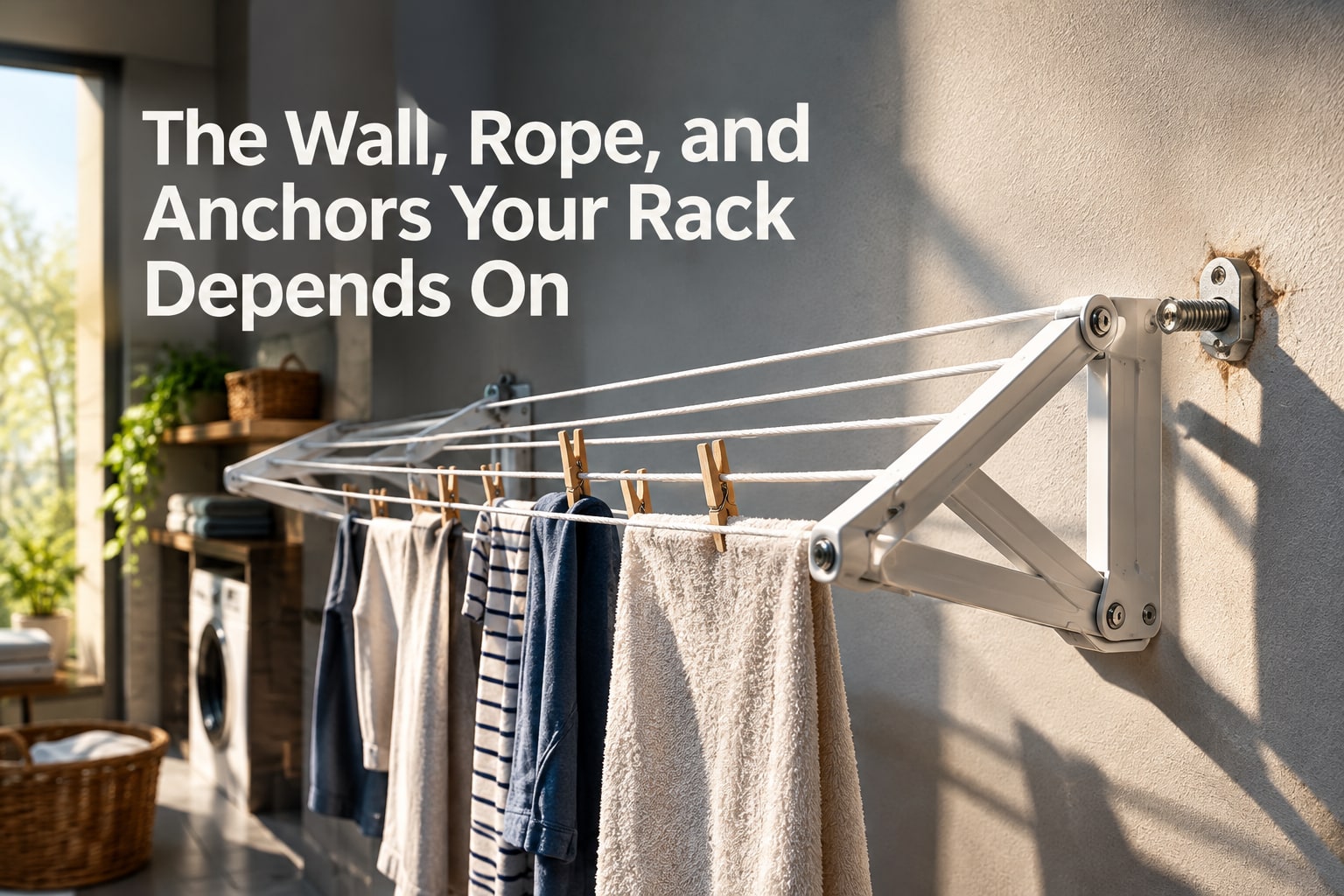
The fixing is safe only when the complete anchor-in-wall assembly carries the opened rack, not when a screw’s advertised tensile strength looks impressive. Survey the wall for its material, plaster thickness, voids, cracks, available embedment depth, and hidden pipes or wiring before drilling.
- Reinforced concrete: use a rated expansion anchor or injection anchor, a carbide masonry bit, and embedment measured into sound concrete beyond the plaster.
- Solid brick: use a suitable nylon plug or sleeve anchor with masonry screws; drill into the brick, not the mortar joint.
- Hollow block: use a cavity-rated toggle, sleeve, or chemical anchor; avoid relying on a short plug that grips only one thin face.
- Aerated concrete: use an AAC-rated screw or anchor and its specified wide embedment; ordinary concrete plugs can pull out.
- Tile over masonry: drill the tile with a tile or diamond bit without hammer action, then continue into masonry for the anchor’s full depth.
- Gypsum-board partition: fix into a structural stud or backing; a hollow-wall toggle alone is not adequate for a projecting rack.
At the bracket, wet clothes create bending moment and pull-out force: 15 kg at 0.5 m produces about 7.5 kg·m before uneven loading, impact, or wind on an exposed balcony. Check this for a mild steel cloth drying rack, including one line loaded more heavily than the others.
Open the rack fully, apply the declared wet load uniformly, and hold it for the proof-load factor and time written into the purchase specification, such as 1.5 times the load for 10 minutes. Inspect for bracket rotation, wall cracking, fastener movement, permanent arm deflection, rope slip, hinge movement, and latch disengagement.
Require a positive open-position stop or latch and separate retention when folded.
Compare mild steel and stainless steel for the installation site
A stainless steel frame suits a humid bathroom or exposed terrace when corrosion resistance matters most; a mild steel cloth drying rack suits a sheltered utility area or covered balcony when controlled cost and weight matter more.
Stainless steel resists corrosion through the metal itself, but joints, fasteners, cut edges, and trapped water can still rust.
| Material | Strengths | Limitations |
|---|---|---|
| Mild steel | Usually lower cost and, depending on design, lower weight | Relies on paint, powder coating, galvanizing, or pretreatment plus coating; damaged areas can rust quickly |
| Stainless steel | Greater inherent corrosion resistance; useful for condensation, splash, rain, and wash-water | Usually costs more; grade, welds, fasteners, and concealed water traps still determine service life |
For a terrace or open window, record direct rain, wind-driven rain, and wash-water exposure. For a bathroom, mark condensation and splash zones. A wall mounted drying rack in coimbatore needs the same site-specific record; a sheltered masonry wall differs from a balcony edge.
Ask for these details before approval:
- Steel grade, coating type, coating thickness or documented process control, weld finishing, drainage holes, and treatment of drilled holes, cut ends, hinge bores, and concealed water traps.
- Inspect coating damage around welds and fasteners. Confirm that hinges, brackets, rope routing, and anchors remain sound.
- Check fastener compatibility. Stainless or galvanized hardware can fail early when water stays trapped against inadequately protected steel.
Write a complete purchase and installation specification
Approve the quote only after receiving one dimensioned drawing or specification for the complete system. It must show rack width, fully opened projection, usable line length, clear line spacing, wet-load rating, load distribution, bracket spacing, hinge and latch details, rope routing, pulley size, rope working load, and anchor type.
Ask the supplier to state:
- Wall substrate, plaster thickness, drilling depth, fixing count, anchor model, and exclusions for weak plaster or hollow partitions.
- Whether the wet-load rating includes the frame, ropes, pulleys, hinges, and wall anchors, and whether it is uniformly distributed or concentrated on one line.
- Rope material, diameter, supplied length, working load, UV basis, expected stretch, and replacement method.
- Retensioning instructions, acceptable sag at the stated span and wet load, and the proof-load factor and hold time for acceptance.
- A site survey covering sheltered or exposed placement, rain, wash-water, balcony-edge wind, open-window clearance, and future service access.
- An installation record with photographs of anchors, plus separate replacement availability for ropes, pulleys, hinges, latches, and corrosion-damaged fasteners.
A search for cloth drying rope wall for folding cloth drying rack in coimbatore must distinguish a rope anchor from a complete folding rack. For a wall mounted drying rack in Coimbatore, compare the installed system:
| Option | Compare | Failure hidden by a cheap quote |
|---|---|---|
| Complete system | Anchors, brackets, frame, rope, pulleys, hinges and latches | Wall or hinge failure |
| Rope alone | Breaking load only | No bracket or anchor capacity |
| Frame price | Purchase cost only | Replacement parts unavailable |
Classic Hangers is most useful when it records these conditions and supplies worn parts separately.
Related services
WALL MOUNT HANGER CLASSIC MS WALL FOLDING ROPE MODEL Drying hanging rack is perfectly designed to save in your laundry or any room. You want to dry your wet clothes. View service → |
WALL MOUNT HANGERS SPACE SAVING DRYING RACK Classic MS wall folding cloth drying rack is perfectly designed to save space laundry or balcony or any room you want to dry... View service → |
Frequently asked questions
How much space should you measure for a wall folding cloth drying rack?
Measure the clear wall width, full-open projection, upper and lower fixing heights, garment clearance, and space around the rack’s folding movement.
What should you specify for a cloth drying rope?
Specify the rope’s material, diameter, coating, breaking load, tensioning method, end fittings, and whether you can replace it without removing the rack.
How do you choose anchors for a wall mounted drying rack?
Match the anchor to the wall: use suitable masonry anchors for concrete or brick, cavity fixings for hollow walls, and studs or structural framing for drywall.
Which is better for the installation site: mild steel or stainless steel?
Use stainless steel where the rack faces humidity, salt air, or frequent water exposure; use protected mild steel in drier areas when its coating remains intact.
What belongs in a complete purchase and installation specification?
Record dimensions, projection, rope details, material and finish, fixing points, anchor type, load requirement, installation height, clearances, and testing instructions.
Related services
WALL MOUNT HANGER Wall foldable hanger is made of stainless steel. It’s a space saving system and easy to use – just pull it up to use and when done, pull down. View service → |
WALL MOUNT HANGER Compact retractable wall mounted cloth dryer stand is designed to maximize your limited space. View service → |