

The value depends on more than a stainless label: you need to match the system to your available space, wet-laundry load, exposure to water and salt, and expected service life. By comparing rope, rod, wall-mounted and ceiling-mounted designs, then checking materials, capacity, stability and maintenance, you can decide whether the premium earns its cost.
Key takeaways
- Choose the drying format before comparing stainless steel with other materials.
- Check usable line length, rated load, footprint and anti-tip stability.
- Include installation, maintenance, replacement and space costs in your comparison.
- Demand material grade, load guidance, dimensions and warranty terms before buying.
Which type of drying system are you actually comparing?
A cloth drying rope stand can mean a movable freestanding rack, a wall-mounted retractable line, or a ceiling pulley hanger. These formats differ in usable drying length, occupied area, installation effort, load path and failure consequences—not simply in whether the metal is stainless steel.
| Format | Construction | When it is worth considering |
|---|---|---|
| Freestanding rope-style rack | A portable frame carries rods, lines or wire spans and moves without fixed anchors. | Choose it for renting, changing layouts, or balconies where you need to clear the area after drying. |
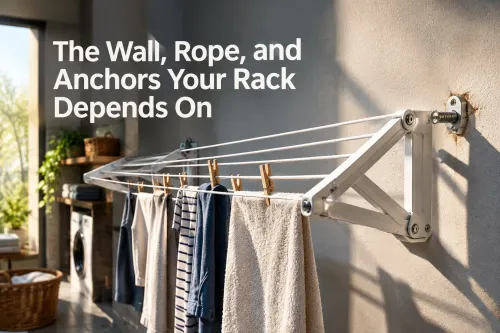
| Wall-mounted retractable rope system | A spring-loaded or manually extended line transfers wet-load forces into brackets and the wall substrate. | Choose it when floor clearance matters and masonry or another verified structure can accept the anchors. |
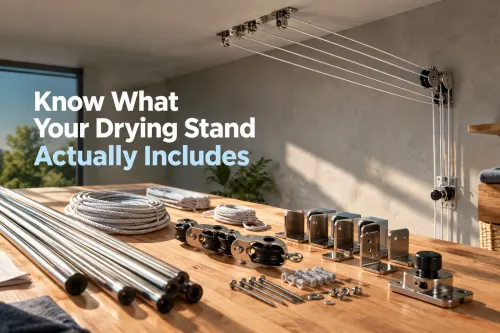
| Ceiling pulley hanger | Raised lines use pulleys, anchors and tensioned operating cords; the ceiling carries the reactions. | Choose it when vertical space is available and fixing into a structural joist, concrete slab or designed support frame is possible. |
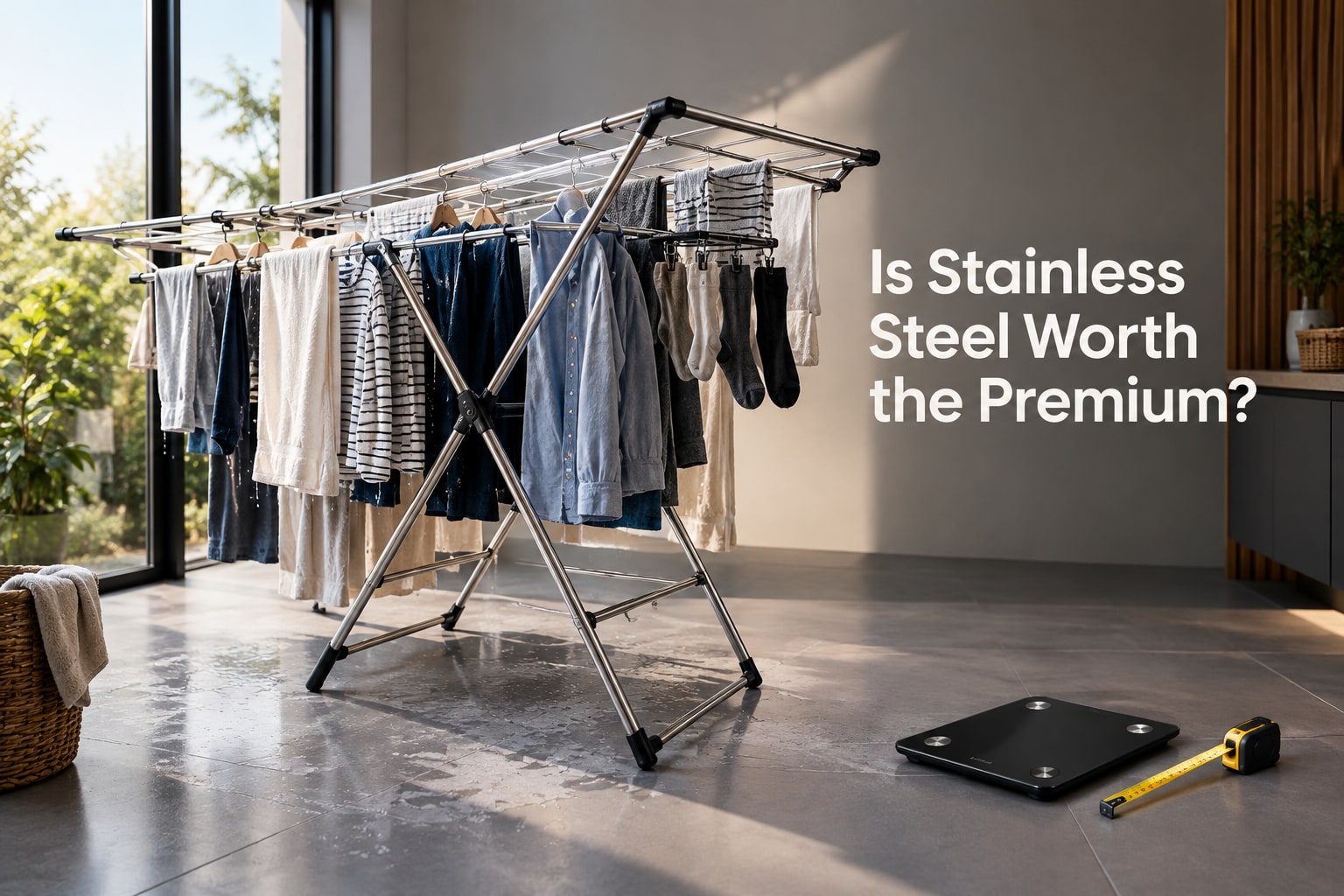
| Foldable cloth drying stand | Hinged sections use fixed rods rather than rope spans and fold for storage. | Choose it when you want simple placement without drilling, but inspect locks and hinges because collapse under a shifting wet load is the main failure risk. |
For balconies and terraces, include wind exposure, uplift and overturning in the first choice; an indoor system and an outdoor one do not face the same loads. A movable stand suits renters, while a wall or ceiling system makes more sense only when floor clearance matters and the structure can carry it.
Does stainless steel justify its premium over other materials?
A stainless steel for cloth drying rope stand earns its premium when repeated moisture, detergent vapour, rain or coastal air would quickly damage painted mild steel. AISI 304 is the usual indoor baseline; AISI 316 is the stronger coastal choice because its molybdenum content improves resistance to chloride pitting.
AISI 202 costs less but offers less protection in aggressive environments.
| Option | Corrosion | Rigidity | Weight | Repairability | Service life |
|---|---|---|---|---|---|
| Mild steel | Rusts after coating damage | High | High | Easy to weld | Moderate indoors |
| Aluminium | Good, but vulnerable at joints | Medium | Low | Specialist repair | Moderate to long |
| Plastic | No rust, but UV and cracking risks | Low to medium | Low | Replace parts | Short to moderate |
| Nylon rope | No metal corrosion | Low; stretches | Very low | Cheap to replace | Reduced by UV and abrasion |
| Stainless steel or wire | Strong resistance; inspect crevices | High | Medium to high | Hardware replacement required | Long with maintenance |
Specify the grade separately for frame, rope or wire, screws, hinges, pulleys, brackets and fittings. A stainless steel cloth drying stand can still fail around plated carbon-steel hardware through galvanic corrosion where dissimilar metals meet wet detergent residue.
Inspect welds, tube ends, folded joints, screw heads and rope terminations for tea staining, pitting and crevice corrosion. Nylon runs quietly but stretches and ages under ultraviolet light; stainless wire resists abrasion but broken wires create sharp hazards, so use properly swaged or shielded ends.
Avoid hydrochloric-acid cleaners and prolonged wet contact with bleach or hypochlorite. Rinse and dry the stand.
What size, load and stability checks prevent a costly mistake?
1. Record the stainless steel cloth drying stand’s open dimensions, folded dimensions, stand height, base width, usable rod or rope length, number of rods and total lineal drying length.
Measure the balcony, utility area, bathroom or terrace with the stand fully open; preserve a walking path, check door and cabinet swing, leave wall clearance, and verify ceiling height for raised lines or pulley operation.
2. Ask for the safe working load and confirm whether it applies per rope, per bay or to the complete stand. Wet laundry weighs far more than dry clothing, and the weakest element sets capacity: rope, eye, crimp, pulley, bracket, hinge, anchor or wall substrate.
3. Distribute laundry across the rods rather than hanging everything on one side. Multiple lines do not automatically provide twice the capacity because sag, friction and uneven loading can shift force to one attachment or frame member.
For a foldable cloth drying stand, require positive open-position locks, captive stops, hinge pinch protection and a defined hinge inspection cycle.
4. Check the floor before accepting the stand. Smooth tile, uneven flooring and wet floors require suitable feet, non-slip pads, levelling, ballast or anchoring, stated in the specification.
5. Outdoors, assess wind uplift, overturning and anchor pull-out as well as garment weight. A large wet load catches wind, so an indoor rating does not prove that the stand is safe on a balcony or terrace.
How does the total cost compare with other drying solutions?
A stainless steel cloth drying stand earns its premium only when its usable drying length, service life and space savings outweigh purchase and installation costs. Compare the complete system, not the metal label.
| Option | Cost and capacity | Space, upkeep and life |
|---|---|---|
| Stainless steel | Higher purchase cost; compare usable lineal length, not rod count | Freestanding floor area remains; cleaning is simple, repairs need accessible joints; replacement interval is longer when wet exposure is frequent |
| Painted mild steel | Lower initial cost indoors while the coating remains intact | Scratches expose steel to rust, increasing touch-up, maintenance and replacement costs |
| Aluminium, plastic or nylon rope | Lower weight and, for nylon, inexpensive line replacement | Less stiffness, load confidence or wear resistance; nylon stretches and ages under ultraviolet light |
| Wall-mounted retractable | Pays for saved floor area rather than maximum capacity | Requires sound anchors; brackets, springs and housings remain exposed to corrosion and can be difficult to repair |
A ceiling pulley system uses vertical space efficiently, but its quote must separate clothes load from installation load. Fixings into a structural joist, concrete slab or engineered support frame are not equivalent to plasterboard or a suspended ceiling grid; installation time and anchor work can dominate the price.
For a cloth stand for businesses, require a written safe-load rating, component materials, inspection intervals and replacement criteria. Ask whether the rating applies per rope, per bay or to the complete stand, and include cleaning effort and access to ropes, pulleys and fasteners in the service calculation.
Procurement teams comparing suppliers such as Classic Hangers should compare those documents and the installed system, not a stainless frame in isolation.
Related services
FOLDABLE STAND CLASSIC STAINLESS STEEL X MODEL STAND SPACE SAVING : Stainless steel easily foldable clothes dryer stands can be folded down and extend out to conserve space. View service → |
FOLDABLE STAND CLASSIC STAINLESS STEEL BUTTERFLY STAND DESIGN AND UNIQUE FEATURES : 100 % Stainless Steel including Screws and Fasteners making it rust and corrosion free. View service → |
What should you demand before deciding it is worth buying?
1. Demand a written specification for the cloth drying rope stand: stainless grade for every metal component, open and folded dimensions, usable drying length, rod count, stand height, base width, safe working load, load basis, and installation instructions. The load basis must state whether capacity applies per rope, bay, or complete stand.
2. Inspect weld finish, drainage, hollow tube ends, rope or wire terminations, pulleys, screws, fasteners, feet, hinges, and locking pins. Stainless steel on the main tube does not prove that every part resists corrosion; ungraded hardware can rust first.
3. For frequent use, require inspection and replacement criteria for frayed or kinked rope, flattened strands, loose crimps, seized pulleys, cracked plastic, bent frames, corrosion pits, missing locks, and loose anchors. A visual check cannot establish the original working-load rating.
4. Reject any design that hides lines, traps water, spaces garments tightly, or folds without a positive lock. Ask how you will reach each rope, pulley, hinge, and fastener for cleaning and replacement.
5. Clean detergent residue, rinse chloride cleaners promptly, and dry trapped joints. These steps limit tea staining, pitting, and crevice corrosion.
A stainless steel cloth drying rope stand is worth the premium when repeated moisture, detergent vapour, outdoor humidity, or coastal air would shorten painted steel’s life, and the system has a documented load rating and stable installation.
Do not pay extra for an ungraded assembly with weak hinges, inaccessible lines, poor spacing, or no evidence that the floor, wall, or ceiling can carry it.
Frequently asked questions
Which type of drying system are you actually comparing?
Compare a freestanding foldable cloth drying stand with wall-mounted retractable lines and ceiling pulley systems by usable drying length, occupied area, installation effort and failure consequences.
Does stainless steel justify its premium over other materials?
Stainless steel earns its premium when corrosion resistance, wet-clothing exposure and long service life matter. Compare it with coated steel, aluminium and plastic by durability, finish, joints and maintenance.
What size, load and stability checks prevent a costly mistake?
Measure usable line length and open footprint, check the stated load guidance, inspect hinges and joints, and confirm the stand remains stable with wet laundry distributed across it.
How does the total cost compare with other drying solutions?
Compare purchase price with installation, usable capacity, maintenance, replacement risk and the floor or ceiling space each system consumes.
What should you demand before deciding it is worth buying?
Ask for the stainless-steel grade, dimensions, rated load, care instructions, installation requirements, spare-part availability and written warranty terms.
Related services
FOLDABLE STAND CLASSIC STAINLESS STEEL BUTTERFLY 2 STEP STAND DESIGN AND UNIQUE FEATURES : 100 % Stainless Steel including Screws and Fasteners making it rust free. View service → |
FOLDABLE STAND CLASSIC STAINLESS STEEL BABY STAND DESIGN AND UNIQUE FEATURES : 100 % Stainless Steel including Screws and Fasteners making it rust . View service → |
FOLDABLE STAND CLASSIC 3 LAYER FOLDABLE STAND DESIGN AND UNIQUE FEATURES : 100 % Stainless Steel including Screws and Fasteners making it rust and corrosion free. View service → |