

A product label rarely tells you whether the box contains the rope, pulleys, anchors and tensioners needed to install a working system. By checking the parts, material grades, dimensions, load rating and substrate requirements, you can compare a ceiling or wall model with a freestanding stand before paying for an incomplete kit.
Key takeaways
- Confirm the frame, rope, pulleys, tensioners and anchors before accepting delivery.
- Check rope material, diameter, length and rated load separately from steel claims.
- Measure the number of usable drying lines, not only the stand’s outer dimensions.
- Match anchors and screws to your ceiling, wall material and installation location.
Check every part listed in the package
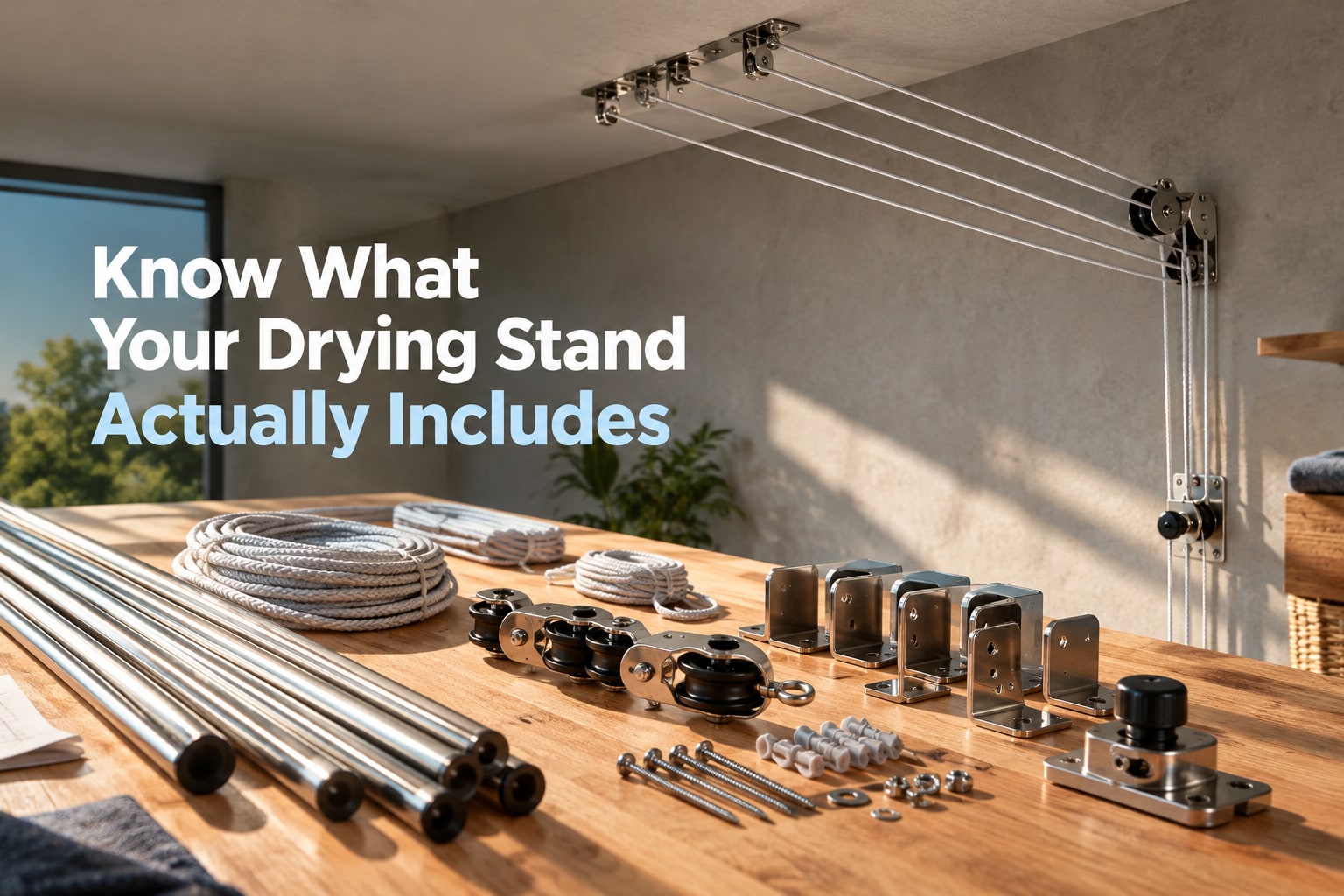
A complete package for a stainless steel cloth dryer stand should contain the load-bearing frame, drying rope, pulleys or eyelets, tensioning parts, and installation hardware. Check the carton against the product sheet before accepting delivery; a missing anchor or end cap can stop installation.
- Frame, wall brackets, or ceiling mounting plates
- Drying rope or wire, with the stated diameter, material, number of lines, and maximum stretched length
- Pulleys, sheaves, or rope-guiding eyelets
- Rope tensioner, locking cleat, hooks, or end stops
- Spacers, washers, end caps, and locking joints
- Screws, nuts, bolts, and other fasteners
- Wall plugs or ceiling anchors suited to the stated fixing method
- Installation instructions showing hole spacing, clearance, rope routing, and tensioning
- Replacement-rope details and the parts covered by the warranty
Do not assume “stainless steel” describes every item. Confirm the steel grade and ask whether the frame, brackets, plates, screws, pulleys, hooks, and rope fittings use stainless steel; plated mild-steel hardware can rust first. A general-purpose screw set may not suit concrete, brick, tile, or hollow block, so substrate-specific anchors might still be needed.
For humid rooms and balconies, inspect tube ends, hinges, and mounting plates for drainage paths. Trapped water causes staining and crevice corrosion, even when the visible frame remains bright. Also confirm that the quoted load rating applies to the complete installed assembly, not the frame alone.
Separate stainless steel claims from rope specifications
“Stainless steel” identifies the frame material only unless the listing names the grade and material of every part. It does not prove that the rope, pulleys, screws, hooks, end caps, or tensioners are stainless steel. Ask whether the tubing is stainless steel rather than plated mild steel, and request the grade used for load-bearing parts.
Separate the steel claim from the cloth drying rope stand specifications. Confirm these details in writing:
- Frame: steel grade, tube thickness, overall width and height, product weight, maximum load, and whether brackets, mounting plates, hinges, and fasteners use stainless steel.
- Rope: material, diameter, number of parallel lines, spacing between lines, maximum stretched length, and usable length after knots, pulley travel, end clearances, and tensioners.
- Other parts: pulley or eyelet material, rope stops, tensioner type, spacers, end caps, wall or ceiling plates, screws, plugs, anchors, and installation instructions.
The usable rope length is the sum of the individual lines, not the outside frame width multiplied by an assumed line count.
A listing for a stainless steel model for cloth drying rope stand in Coimbatore still needs checking for humidity and wet-dry cycling: water trapped inside tube ends, hinges, or wall plates can cause staining and crevice corrosion. Look for drainage, ventilation around joints, and substrate-specific anchors rather than assuming “ready to install” includes them.
Measure usable drying capacity, not just outside size
Usable capacity comes from total exposed line length and the complete assembly’s rated load, not the stand’s outside width. A six-line stand provides six times its usable line length, but pulley travel, knots, tensioners and end clearances reduce the length available for clothes.
Ask for these cloth drying rope stand specifications in writing:
- Maximum open frame length, width and height
- Actual usable length of each parallel line
- Number of individual lines and clear spacing between them
- Maximum stretched length and the rope’s diameter
- Maximum load for the fully installed assembly, stated for wet laundry
- Folded dimensions and product weight, if the stand is movable
- Wall-plate size, hole pattern, wall projection and minimum clearance for wall-mounted models
| Figure | What to request | Why it matters |
|---|---|---|
| Usable line length | Length of every exposed line, then the total | Shows the space available for garments; outside width does not |
| Line spacing | Centre-to-centre distance between ropes | Narrow spacing restricts thick towels and slows airflow |
| Load rating | Kilograms for the complete installed stand, with evenly distributed wet clothing | Prevents overloading one section or treating a dry-load figure as safe for wet laundry |
| Wall projection | Distance from wall plate to the outer line | Stops wet garments rubbing against the wall and confirms pulley travel |
| Installation clearance | Required space above, below and beside the stand | Reveals whether lines can move and whether the frame can open fully |
Do not accept a garment count as the capacity figure. Fabric weight, garment size, spin-dry level and spacing change that number; compare total usable line length and the wet-load rating instead.
Match the supplied hardware to your ceiling or wall
Do not drill until you know the base material, fixing points and finished clearance. A search for “steel drying stand near me” does not confirm that the supplied screws suit your concrete ceiling, solid brick wall, hollow block or gypsum board.
1. Match the kit to the installation method. Confirm the frame or wall plates, pulleys or eyelets, rope, spacers, end caps, tensioner, hooks and instructions are present. Check whether the kit includes ceiling plates or brackets, plugs and screws.
2. Identify the substrate at every fixing point. Use masonry anchors for concrete or solid brick, suitable hollow-wall anchors for hollow block, and rated cavity fixings or a timber member behind gypsum board. Verify pull-out capacity for the actual anchor and base material; general-purpose screws are not universal ceiling fixings.
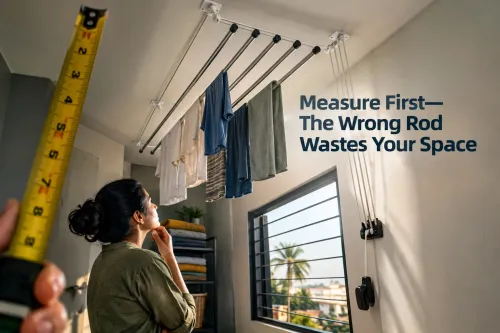
3. Measure the installation zone before drilling. For a wall-mounted unit, record plate dimensions, hole spacing, projection from the wall and the minimum clearance needed to stop wet clothes rubbing against it. Leave ventilation and drainage around joints, folded hinges and tube ends, where trapped water causes staining or crevice corrosion.
4. Confirm the tools: tape measure, pencil, level, drill, substrate-matched bits, anchor-setting tool, screwdriver or spanner, and a stable step ladder for ceiling work. Test the rope travel and pulley alignment after marking, before tightening every fastener.
A supplier should state whether the quoted load rating applies to the complete installed assembly, not merely the stainless frame.
Use a written checklist when comparing local options
Use one written comparison sheet for each quote: a ceiling rope system needs ceiling-route and anchor checks, while a foldable stand needs open and folded measurements.
| Feature | Ceiling rope system | Foldable stand |
|---|---|---|
| Space check | Record ceiling length, rope travel, pulley positions, and clearance below the ceiling. | Record open width, height, footprint, folded thickness, hinge clearance, and locking method. |
| Load check | Confirm the rating applies to the complete installed assembly, including anchors and ropes. | Confirm the frame’s maximum load and how that load is distributed across rods or lines. |
| Humidity check | Ask how joints, pulleys, and ceiling plates drain and ventilate. | Check whether folded hinges and tube ends trap water during wet-dry cycles. |
| Delivery check | List plates, pulleys, rope, tensioner, end stops, fasteners, plugs, and instructions. | List the frame, locking joints, end caps, feet, fasteners, and instructions. |
Complete the sheet before choosing a steel drying stand near me result or a foldable drying stand in coimbatore listing:
- Record the stainless-steel grade, tube or wire dimensions, finish, weld quality, and which parts are not stainless steel.
- Ask whether replacement rope or line is available, and write down warranty exclusions.
- Match supplied anchors to concrete, solid brick, hollow block, or gypsum board; general-purpose screws do not prove suitability.
- Confirm the folded frame can be secured against wind or accidental opening.
- Ask Classic Hangers to identify every item included and state the quoted load rating for the supplied, installed configuration.
Related services
CEILING CLOTH DRYING HANGERS Its basic I model. the centre I shape only stainless steel. write side 3 rope and left side 3 rope. its available for 5 to 8 feet length. View service → |
FOLDABLE STAND CLASSIC STAINLESS STEEL X MODEL STAND SPACE SAVING : Stainless steel easily foldable clothes dryer stands can be folded down and extend out to conserve space. View service → |
Frequently asked questions
What parts should come with a stainless steel cloth drying rope stand?
Check for the load-bearing frame, drying rope, pulleys or eyelets, tensioning parts, end caps and installation hardware listed on the product sheet.
How do stainless steel claims differ from rope specifications?
Stainless steel describes the frame or fittings, while rope specifications cover material, diameter, length, tension and load capacity. Assess each separately.
How do you measure a cloth drying stand’s usable capacity?
Count the actual drying lines and measure their usable length after allowing for pulleys, end caps, tensioners and clearance from walls.
How do you match supplied hardware to a ceiling or wall?
Identify the mounting surface first, then check whether the supplied screws and anchors suit concrete, brick, tile, wood or another substrate.
What should you compare when choosing local drying stand options?
Use a written checklist covering every included part, steel grade claim, rope specifications, usable capacity, hardware suitability and installation requirements.
Related services
FOLDABLE STAND CLASSIC STAINLESS STEEL BUTTERFLY STAND DESIGN AND UNIQUE FEATURES : 100 % Stainless Steel including Screws and Fasteners making it rust and corrosion free. View service → |
FOLDABLE STAND CLASSIC STAINLESS STEEL BUTTERFLY 2 STEP STAND DESIGN AND UNIQUE FEATURES : 100 % Stainless Steel including Screws and Fasteners making it rust free. View service → |
FOLDABLE STAND CLASSIC STAINLESS STEEL BABY STAND DESIGN AND UNIQUE FEATURES : 100 % Stainless Steel including Screws and Fasteners making it rust . View service → |
CEILING CLOTH DRYING HANGERS CLASSIC - SINGLE ROD CEILING HANGERS pulley cloth drying hangers is fitted to ceiling /roof to conveniently hang your clothes in available space like utility, balcony, veranda, bathroom... View service → |