


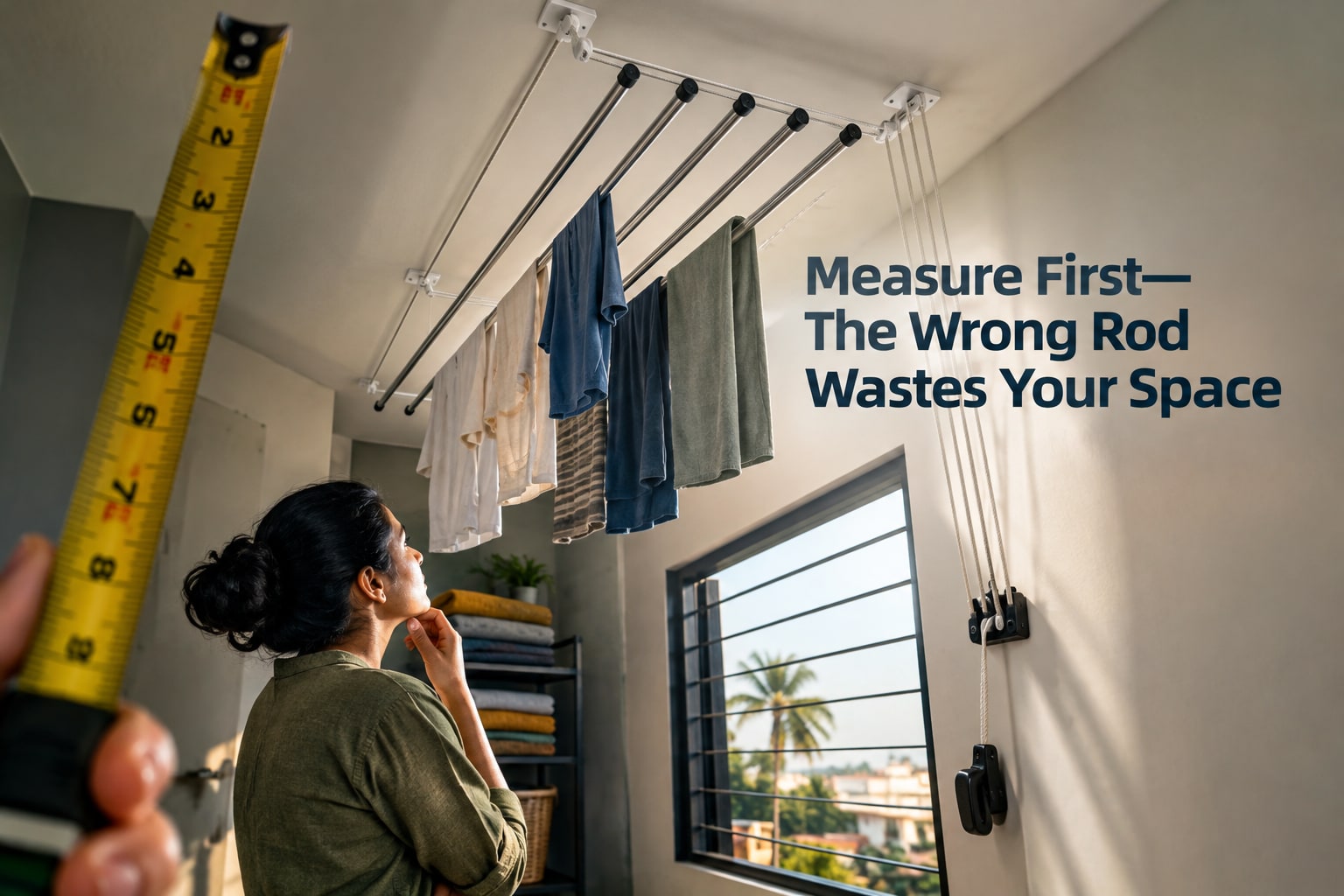
Strong sun does not guarantee reliable drying when monsoon humidity, limited balcony space, and indoor moisture enter the decision. You will be able to measure your room, compare five drying formats, choose the correct rod length, and specify a safe installation without relying on vague load or rust-proof claims.
Key takeaways
- Choose a ceiling system when overhead space preserves walking room.
- Measure clear width, depth, ceiling height, and pulley clearance before ordering.
- Keep wet garments spaced apart to improve airflow and reduce drying time.
- Specify the fixing surface, rod length, rope route, and load before installation.
Choose the drying format for your space and weather
Choose by usable airflow, walking space, and how much laundry you wash at once. A ceiling cloth drying system suits a compact home when the ceiling is sound and you want drying space above head level. A ceiling rope adjusts the rack’s height; it does not make a heavy wet load effortless to lift.
| Option | Best fit | Main limitation |
|---|---|---|
| Ceiling system with parallel rods | Regular family loads, balconies, utility areas, and humid or rainy weather where airflow matters | Needs accurate ceiling fixing and enough operating clearance |
| Ceiling rope with one rod | Small loads and rooms where you need to lower clothes for loading | Garments overlap when packed tightly, so drying slows |
| Wall-mounted folding rack | Homes with concealed ceiling wiring, plumbing, or fragile false ceilings | The wall must resist pull-out and bending forces when extended |
| Single rod cloth hanger | Very narrow spaces and light daily washing | Lower usable capacity because overlapping garments reduce exposed fabric |
| Freestanding stand | Tenanted homes, flexible placement, or occasional indoor drying | Uses floor area and can obstruct movement or airflow |
For a compact Coimbatore home, choose parallel ceiling rods for frequent loads, provided the ceiling is structurally suitable. Choose a wall-mounted rack when ceiling drilling is unsafe. A single rod or cloth drying rope in Coimbatore works for one person’s lighter load, but not when clothes must dry quickly during damp weather.
Keep the rod away from doors, windows, and walls; wet fabric needs air space rather than tightly packed length. A freestanding stand is the fallback when you cannot drill.
Measure the room before choosing a 5-, 6-, 7-, or 8-foot rod
Measure the clear usable span, not the wall’s full length. A rod fits only when its length, end brackets, pulley paths, and wall clearance stay inside that span without entering a door or window swing.
| Rod length | Choose it when the measured clear span is at least | Practical limitation |
|---|---|---|
| 5 feet | 5 feet plus the installer’s end-clearance allowance | Suits a narrow utility area or small balcony |
| 6 feet | 6 feet plus end-clearance allowance | Gives more hanging length but needs a longer unobstructed wall-to-wall span |
| 7 feet | 7 feet plus end-clearance allowance | Reject it if one end approaches a door, window, or corner |
| 8 feet | 8 feet plus end-clearance allowance | Needs a long, uninterrupted ceiling or balcony run |
Use masking tape to mark the proposed rod footprint on the ceiling or floor. Check the opened door, window shutters, cupboard doors, and your walking route; keep the operating rope reachable without standing in the passage.
For a multiple-rod layout, measure the available width across the rods, then reserve space for garments to hang freely without touching the wall or neighbouring clothes. If that width is tight, a single rod ceiling drying system is safer than forcing parallel rods that block airflow and create overlapping laundry.
- Record the available length, usable width, ceiling height, wall clearance, and pulley operating height.
- Mark the lowest hanging garment and confirm it does not obstruct heads, shelves, fans, or windows.
- Compare the load against your laundry volume: a single rod cloth hanger saves space, but close-packed garments overlap and dry more slowly.
Operate the ceiling cloth drying rope without tilting or tangling
A ceiling cloth drying rope should run through aligned guide pulleys, with both rope ends equal in length so the rod rises level. Route each end straight down without crossing or rubbing against the bracket; a sideward pull makes the rod twist, while uneven garments make one end descend faster.
- Pull steadily from below the operating point, keeping the rope close to vertical. Do not jerk it or pull at an angle.
- Load the rod from the centre outward, spreading wet garments across its full length. Heavy towels at one end will tilt the rod and can jam it against the guides.
- Raise the rod only to the height needed for airflow and walking clearance. Engage the cleat, cam lock, geared winder, or other positive parking device before releasing the rope.
- Lower the empty rack once after installation, then repeat with gradually increased, evenly distributed weight. Check rope tracking, pulley alignment, anchor movement, rod deflection, and the lock.
| Option | How it works | Main limitation |
|---|---|---|
| Ceiling pulley rope | Changes rod height; a single fixed pulley changes pulling direction, not the load weight | It is not an effortless hoist unless it has counterweight or mechanical advantage |
| Clothesline | Provides a flexible line between two fixed points | It does not keep garments on a level, rigid drying plane |
| Rigid rod | Holds its shape and needs no rope operation | It cannot be raised or parked overhead without a separate mechanism |
Choose polyester rope for lower stretch, moisture absorption, and sunlight exposure. Nylon can elongate after absorbing moisture, allowing the rod to lose height or become uneven.
Plan wet loads and verify the ceiling or wall fixing
Start with the wet laundry, not the empty rack. A permitted wet-load rating must cover the complete installed assembly—rack, rods, rope, pulleys, anchors and locking hardware—not just the rack component. State whether that rating covers a specified number of garments or rods.
Wet clothes bunch at a few points; uneven loading causes tilting, sagging and jamming.
Before approving a cloth drying system in Coimbatore, check these installation points:
- Fix a ceiling system to a reinforced-concrete slab, beam or verified structural member. Do not anchor it only to gypsum board, plaster, tiles or a false-ceiling frame.
- Locate concealed electrical conduits, plumbing and reinforcement before drilling. A visible ceiling finish does not prove that the space behind it is safe or strong enough.
- Choose anchors for the actual substrate and rated load. Record the anchor type, fixing depth and spacing in the installation specification.
- For a wall rack, verify solid masonry or reinforced concrete behind every fixing point. The folded-out rack creates pull-out and bending forces that increase with distance from the wall.
- Check that the wall, ceiling and mounting plate remain flat and aligned. A skewed plate misaligns pulleys and makes a loaded rack jam.
- Raise and lower the empty rack, then add an evenly distributed load in stages. Watch for anchor movement, rope tracking, pulley alignment, rod deflection and lock failure.
- Repeat the test with the intended wet load, including the heaviest garments. Stop if any fixing shifts, the rod bends sharply or the rope slips.
Turn your measurements into a Coimbatore installation specification
Ask for a written specification before approving: it should turn your measurements into a capacity, fixing, operating and testing statement, not merely a product name. For a cloth drying system and cloth drying rope in Coimbatore, require these points:
1. State the maximum evenly distributed wet load in kilograms, rod length, garment spacing and usable capacity. Separate the safe working load from any claimed lifting capacity.
2. Name every metal: stainless steel grade, aluminium, plated steel or powder-coated steel. Ask how cut edges, fasteners and coating damage resist detergent, sweat and humidity.
3. Specify rope material and diameter, pulley sheave material, bearings, brackets, guides and locking method. A fixed pulley changes direction; it does not make a heavy load effortless.
4. Confirm ceiling height, operating-pull height, wall clearance and airflow around hanging clothes. State where doors, windows and exhaust fans remain unobstructed.
5. For monsoon weeks, identify an indoor or semi-covered drying position, drainage route and ventilation plan. Exposed-balcony-only operation is a reliability gap.
6. Require post-installation proof testing: raise and lower the empty rack, then increase an evenly distributed load while checking rope tracking, pulley alignment, anchor movement, rod level, deflection and lock engagement.
Classic Hangers should record these figures on the installation sheet so you can compare the delivered cloth drying system in Coimbatore with the approved specification.
Related services
WALL MOUNT HANGER CLASSIC MS WALL FOLDING ROPE MODEL Drying hanging rack is perfectly designed to save in your laundry or any room. You want to dry your wet clothes. View service → |
CEILING CLOTH DRYING HANGERS CLASSIC - SINGLE ROD CEILING HANGERS pulley cloth drying hangers is fitted to ceiling /roof to conveniently hang your clothes in available space like utility, balcony, veranda, bathroom... View service → |
Frequently asked questions
Which drying format suits a compact home in Coimbatore?
Choose a ceiling system when you have sound overhead fixing space and want to keep floors and walkways clear. Use a wall-mounted rack when ceiling access is unsuitable, and use a foldable stand when you need to move the drying area.
How do you choose between a 5-, 6-, 7-, or 8-foot drying rod?
Measure the usable installation width after allowing for walls, doors, windows, and walking clearance. Select the longest rod that leaves room to operate the rack and spread garments without crowding.
How do you operate a ceiling cloth drying rope without tilting the rack?
Pull the rope smoothly and keep the rack level as it rises or lowers. Avoid jerking one side, overloading one end, or allowing the rope to cross and tangle around the pulley.
What should you verify before installing a ceiling or wall drying system?
Identify the fixing surface, locate solid concrete or suitable structural members, check the expected wet-load weight, and confirm that the rope path and rack clearance remain unobstructed.
Related services
CEILING CLOTH DRYING HANGERS CLASSIC - SINGLE ROD WALL MOUNT HANGERS pulley cloth drying hangers is fitted to ceiling /roof to conveniently hang your clothes in available space like utility, balcony, veranda, bathroom... View service → |
WALL MOUNT HANGERS SPACE SAVING DRYING RACK Classic MS wall folding cloth drying rack is perfectly designed to save space laundry or balcony or any room you want to dry... View service → |
CEILING CLOTH DRYING HANGERS Its basic I model. the centre I shape only stainless steel. write side 3 rope and left side 3 rope. its available for 5 to 8 feet length. View service → |
FOLDABLE STAND CLASSIC STAINLESS STEEL X MODEL STAND SPACE SAVING : Stainless steel easily foldable clothes dryer stands can be folded down and extend out to conserve space. View service → |